Facts
- Master (2 years)
About the programme
The Master's programme in Choral Conducting is a practice-oriented artistic education based on high professional competence. Its purpose is to make you a proactive, competent and well-informed choral conductor who understands how to translate reflection into professional action. The programme is holistic and aims to help you develop your own artistic and professional profile as a basis for a multifaceted career in music and cultural life.
Content and activities
During your master's degree, you will acquire knowledge, competencies and skills to enable you to perform as a choir director at the highest level and to contribute to the development of the musical labor market and the arts and cultural life. This is something you will have the opportunity to try out in the large community-oriented project in the second semester, where you put your music and your professionalism into play in a socially and welfare-relevant context in close collaboration with an external partner. The master's program is a well-rounded education that gives you a foundation for a sustainable musical, artistic and pedagogical working life.
Your education is primarily individual and includes elements such as structural analysis, text analysis, understanding the connection between text and music, verbal and physical communication, and nuanced conducting techniques.
In addition, you can also look forward to two types of internships during the programme:
1) internship supervision with your own choir
2) internships with different types of choirs that the Academy buys access to
Other subjects on the programme include ensemble conducting, aural analysis, singing and voice theory.
The complete musician
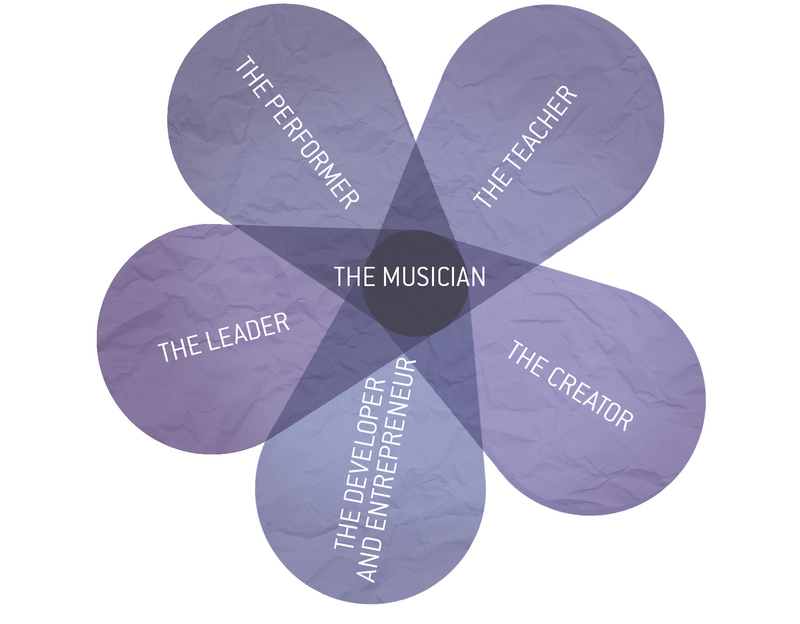
The Master's program focuses on five important and mutually supporting key roles for the professional musician:
THE PERFORMER:
The performer represents the core of musicianship at Danish National Academy of Music. This is where you develop your technical, musical and artistic skills to achieve a high degree of musicality and mastery of your instrument, and to communicate your artistic vision in an engaging way to different audiences.
THE EDUCATOR:
The educator is your ability to communicate and convey your musical knowledge and skills. Teaching is a central part of many musicians' careers, which is why the programmes offer a strong pedagogical foundation, where you will learn to plan and implement teaching programs for different audiences, including children, young people and adults.
THE CREATOR:
The Creator is the role where you explore and develop your own creative practice, whether in composition, improvisation, sound art or concept development. This role supports not only the traditional understanding of creating music, but also innovation in artistic expression and projects.
THE DEVELOPER AND ENTREPRENEUR:
The Developer and Entrepreneur role focuses on preparing you to navigate the economic and organizational realities of music and culture. It gives you the tools to realize your own projects, create new opportunities and build a sustainable career.
THE LEADER:
The leader represents your ability to take responsibility and inspire others. This role is trained through collaboration, project management and organizational understanding, giving you the skills to take on leadership roles in various artistic, musical and interdisciplinary contexts.
FAQ
Typical questions and practical info
Conservatory education in Denmark consists of a 3-year bachelor's degree, a 2-year master's degree and an additional 2-year soloist program.
The master's programs require that you have passed a bachelor's degree from a Danish or foreign music conservatory - or have equivalent qualifications.
The entrance exams require you to demonstrate your skills on your main instrument/vocal and test you in a number of general subjects such as theory and ear training.
To be announced shortly
All scheduled classes are generally held at SDMK in Odense between 8 am and 6 pm. However, in connection with orchestra projects, masterclasses and other extraordinary teaching, classes may be held outside this time frame.
We have collected a number of general questions and answers about finances, ECTS, study locations, credits, etc. on this page.
If you have any questions regarding the programme, please contact:
- Head of Studies Anders Gustavsen-Sprotte
+45 92159954 / ags@sdmk.dk - Study Secretary Christina Strandby Krog-Jensen
+45 48880077 / ckj@sdmk.dk