About the project
Aural training is an important supporting subject in the rhythmic programme at the conservatory and is also studied at many music schools around the country. For the rhythmic improviser, the subject contains disciplines that are important to train and maintain throughout a lifetime as a musician. Disciplines that help inspire and develop musical orientation, improvisational and compositional skills, not just as a student, but as a musician and composer in general.
This project stems from the desire to develop a concrete material that is an extension of the course the rhythmic students at DNA of Music have in ear training with Hans Mydtskov. The material and the associated collection of exercises can be accessed here: hansmydtskov.dk/ear.
The intention of the project is to link the awareness gained in the course more closely to the main instrument, as ear training is not instrument-based, but deals with the three main musical parameters on a more general level.
This is why the exercises in this project are the way they are.
The first part deals with transcription. Transcription is in a way the ultimate ear training - you deal with melody, harmony and rhythm in the same exercise. The transcribed phrases should be thought of as an introduction to the vast treasure trove of musical possibilities waiting to be exploited. The phrases we have transcribed are phrases we have heard ourselves and that have aroused our curiosity and desire to find out what they contain. They are an introduction to improvisational language and a way of relating melodically and rhythmically to a mostly functional harmonic basis. In ear training, working with harmonies is very much about recognizing harmonic relationships. The further development is that once the recognition is in place, you can begin to relate improvisationally to a harmonic basis and create lines and develop your language. In this context, it is crucial to draw inspiration from what a large number of great artists - who have all done the same thing - have chosen to do.
The section on melody deals with individual harmonies - not in a functional harmonic context - and the melodic phrases generated by hearing a specific chord. There is a desire to link the melodic and harmonic together for the purposes of improvisation and composition. The section aims to strengthen the melodic sense and create a confident sense and awareness of different modalities. The phrases in the section are made in the same way as in the book: hear a chord - sing a phrase that links the melody to the chord. They are meant to serve as inspiration to do the same yourself - listen, sing, play.
The section on rhythms is based on subdivisions and groupings. In ear training, the work with subdivisions is very important. Awareness of subdivisions and the ability to execute them is a basic prerequisite for good 'time', which is a crucial element for any musician. The exercises in this project will connect the rhythmic awareness with the melodic element and move the awareness down to the instrument. Being able to work in different rhythmic layers is an important strengthening of an overall musical expression. The exercises in the project are a direct extension of the rhythmic work in ear training and should stimulate the development of rhythmic ideas in musical expression.
All these ideas have been continuously tested in our teaching. Here they are presented in a structured process that allows for conscious work - based on the main instrument
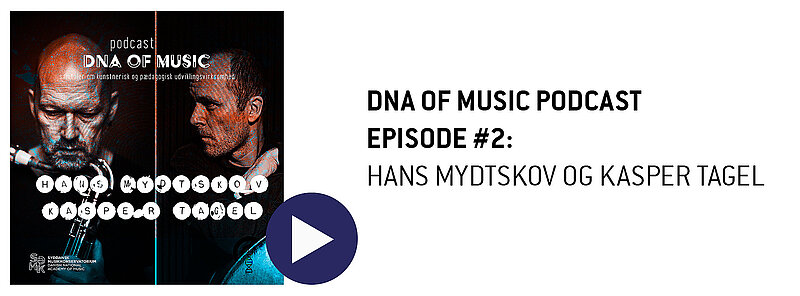
Hear more in the 'DNA of MUSIC' podcast!