Facts
- Bachelor (3 years)
About the programme
The Bachelor's programme Jazz/Pop at Danish National Academy of Music is a practice-oriented artistic education based on high professional standards. You will learn to participate in a variety of contexts where, as a musician, you can be a resource and an asset to the world around you. The programme aims to make you a proactive, competent and well-informed musician who understands how to reflect and translate your reflections into professional action. You will be able to do this thanks to the knowledge, competencies and skills you acquire as a performer, teacher, creator, developer and artistic entrepreneur at Danish National Academy of Music.
The Complete Musician
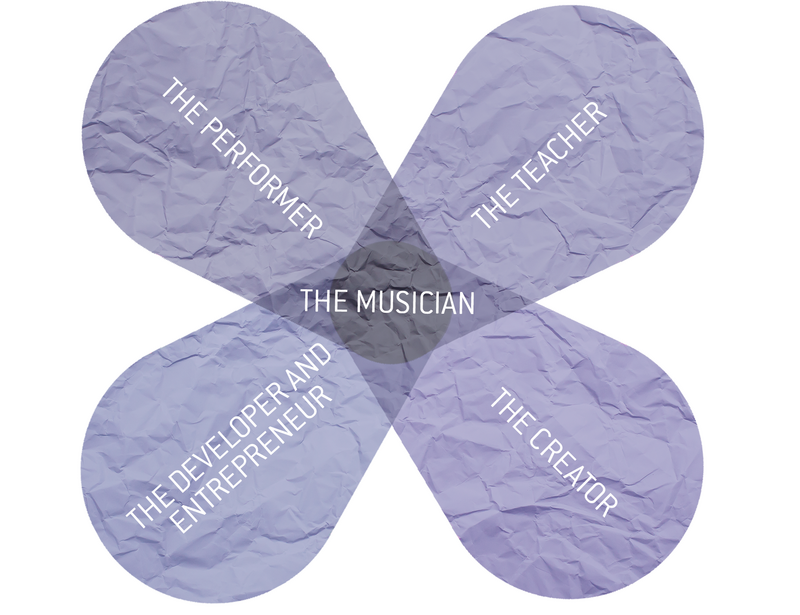
The Bachelor's programme focuses on four important and mutually supportive key roles for the professional musician:
THE PERFORMER:
The performer represents the core of your education at Danish National Academy of Music. This is where you develop your technical, musical and artistic skills, while learning to communicate your artistic vision in an engaging way to different audiences.
THE TEACHER:
The teacher is your ability to communicate and convey your musical knowledge and skills. Teaching is a central part of many musicians' careers, which is why the programmes offer a strong basic pedagogical education, where you learn to plan and implement teaching programmes for different target groups, including children, young people and adults.
THE CREATOR:
The creator is the role in which you explore and develop your own creative practice, whether in composition, improvisation, sound art or concept development. This role supports not only the traditional understanding of creating music, but also innovation in artistic expression and musical projects.
THE DEVELOPER AND ENTREPRENEUR:
The developer and entrepreneur role focuses on preparing you to navigate the economic and organisational realities of music and cultural life. Here you will acquire the tools to realise your own projects, create new opportunities and build a sustainable career.
Schedule, content and activities
The focal point of the Jazz/Pop programme in Odense is jazz in all its forms. The programme combines practical subjects that improve your skills with your voice or instrument with theoretical subjects that give you an understanding of the fundamentals of music. We place great emphasis on both ensemble playing and your work on creating your own music, and you will also have courses in music pedagogy where you learn to teach music to both children and adults. During individual lessons on your instrument, we focus on musical, pedagogical and technical issues, while ensemble lessons help you develop your skills in various musical contexts.
In addition to the scheduled lessons, you can experience masterclasses and workshops with internationally renowned musicians, interdisciplinary focus weeks, concerts at both the academy and professional venues, study trips and much more.
Finally, at DNA of Music we also have a strong focus on musicians' health, so you learn to take care of yourself and avoid unnecessary injuries and challenges.
SCHEDULE
Your schedule will vary from week to week throughout the year. Some subjects are only available for limited periods during the year, while other subjects are available throughout the year. In addition to the scheduled classes, you should plan to set aside time for practicing and for unscheduled study activities such as masterclasses, workshops and concerts. When you do not have scheduled classes, you can reserve available rooms for practicing alone or with other students.
Related programmes
- If you want a programme that focuses more on other genres than jazz, SDMK offers the programme 'Rhythmic Contemporary Musician'
FAQ
Typical questions and practical info
Conservatory education in Denmark consists of a 3-year bachelor's degree, a 2-year master's degree and an additional 2-year soloist program.
Admission to the bachelor's program is based solely on how well you pass the entrance exams, so in principle anyone can apply, as no special educational background is required.
You can generally apply regardless of which instrument you play.
The entrance exams require you to demonstrate your skills on your main instrument/vocal and are tested in a number of general subjects such as theory and ear training. The exams are partly digital and partly in person.
The entrance exams for SDMK's bachelor programs are always in early January. Find the dates for the upcoming exams here.
All scheduled classes are generally held at SDMK in Odense between 8 am and 6 pm. However, in connection with orchestra projects, masterclasses and other extraordinary teaching, classes may be held outside this time frame.
We have collected a number of general questions and answers about finances, ECTS, study locations, credits, etc. on this page.
If you have any questions regarding the programme, please contact:
- Head of Studies Anders Gustavsen-Sprotte
+45 92159954 / ags@sdmk.dk - Study Secretary Kathryn Holbech
+45 404235541 / kh@sdmk.dk