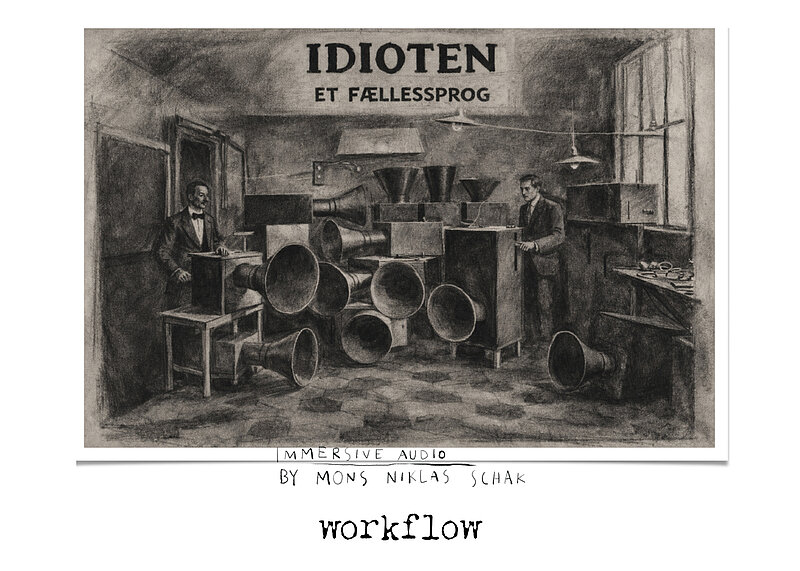
Intro
About the project
The project is based on the collaboration around the creation of music for the documentary Born to Fight, directed by Ala'A Mohsen, with music by Mons Niklas Schak.
The purpose of the project is to document the development of a common language between the film's creative disciplines. Based on reflection and analysis, this common language is structured around four sound perspectives: the acoustic perspective, the perceptual perspective, the cultural perspective and the technological perspective.
In film production, communication barriers between departments are common – and this is precisely where the need for a shared language becomes clear. Not just a language about harmony, melody and rhythm, but one that actually ties the collaboration together across disciplines.
The director carries a visual and narrative vision and wants to move the audience.
For an editor, it's about timing, tempo and rhythm in a coherent narrative.
The sound designer and composer work in the same auditive space, but not always with the same references. A shared language is rarely something you simply have – it's something you build.
Conclusion
The Idiot – A Common Language is a pedagogical development project conducted under the Southern Danish Academy of Music, focusing on the development and testing of a shared conceptual framework for the co-creation of music for film. The project was based on a concrete, professional collaboration on the documentary film Born to Fight between director Alaa Mohsen and composer Mons Niklas Schak, carried out from September 2024 to March 2025.
The project was conducted as a practice-based inquiry, in which the creative process was documented in real time. The focus was not solely on the finished work, but on the fragmented, iterative dialogue and the decision-making processes that arise in the collaboration between director and composer.
The analytical and reflective framework for the project consisted of four sound perspectives: the acoustic, the perceptual, the cultural, and the technological. These perspectives served as structuring tools for formulating and qualifying the dialogue about sound and music across disciplines, and helped to clarify the connections between artistic intentions, technological choices, and audience perception.
As part of the documentation, approximately 25 hours of behind-the-scenes material from the collaborative process were recorded. This material has been edited into four teaching films of approximately 8 minutes each, with each film focusing on one sound perspective. The films constitute a retrospective reflection on the collaboration between director and composer, using concrete examples from the process as the basis for analysis.
The four films have been developed as teaching materials and are intended to make visible and communicate a fragmented creative process that is often difficult to describe through traditional teaching methods. The films offer students a practice-oriented insight into how shared understandings, disagreements, and creative choices emerge and are negotiated in the work with film music.
The project concluded with a joint screening of Born to Fight, supplemented by a presentation and a reflection session with documentary directors from the Danish Film School and composers from the Southern Danish Academy of Music. In addition, a written document has been produced describing the technological processes and workflows from early development to the final delivery of the music, with the aim of strengthening shared structure and clarity in the collaboration between director, composer, sound designer, and editor.
Taken together, the project documents a clear need for a shared, practice-grounded language in the work with film music. The project demonstrates that the four sound perspectives constitute a useful and flexible framework that can support both teaching and professional practice, and contribute to greater clarity, efficiency, and quality in interdisciplinary collaborations.
1. The perceptual perspective:
2. The cultural perspective
3. The acoustic perspective
4. The technological perspective
Workflow
This Keynote presentation is the documentation for the technological perspective. It describes the process of developing, organizing and delivering music for film and serves both as a workflow description and as a framework for practical collaboration between editing, sound and music.