About the project
This project is inspired by my experiences over the past 4 years as an educator at the folk music program at the conservatory in Esbjerg.
My task has been to educate in the very traditional part of the Danish folk music tradition, and in many ways it has been an eye-opener for me.
There has been a big shift in the prerequisites the students come to the folk music program with. The knowledge of traditional dance music has previously been greater, and many of the new students do not have a background in the folk music environment.
Therefore, it has become more important for us educators to integrate traditional music into the teaching of the folk music program to ensure that all students have a thorough knowledge of the foundation on which everything else is built.
It also means that we need to take a look at the way we educate traditional music. How do you teach something as ephemeral as an aural musical tradition without it becoming fixed and artificial?
This is the challenge I have tried to address in this assignment.
I have taken my starting point in the way I learned to play in the folk music environment and have tried to carry the best from there, but along the way I have realized that a more precise way of talking about traditional music and its elements is needed.
This has resulted in a number of compendiums for use by educators of traditional music. Partly a series of melody compendiums with basic material, partly an outline for a methodology in which ear-based ensemble playing gives the music life and power.
I call it the 'free-play method' as it is based on improvisation and open ears.
The second part of the paper consists of a series of reflections and observations on the use of this method in practice and on teaching folk music in general.
It is my hope that this assignment can spark some thoughts among folk musicians and educators about how we pass on not just the music, but the best of folk culture, the taw and the stories.
READ/DOWNLOAD
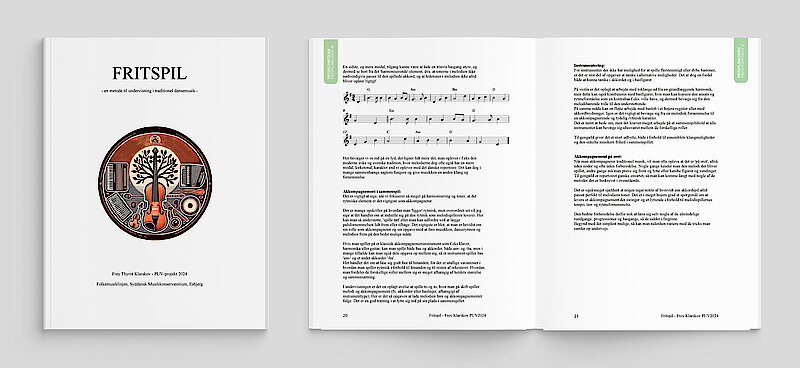
READ OR DOWNLOAD THE FULL PROJECT HERE OR FIND THE INDIVIDUAL SECTIONS IN THE OVERVIEW AT THE BOTTOM OF THE PAGE
methodology and work process
A few words about method and work process:
My assignment for this project was the following:
The project is to qualify the introductory ensemble teaching at the Academy, which is directly based on traditional Danish music.
Although the programme represents many different genres of traditional and contemporary music, traditional Danish music constitutes the unique core of the folk music program at DNA of Music.
With this project, Frey Klarskov wants to develop a method in relation to traditional ensemble playing and a basic material for teaching courses on Danish traditional music that is relevant for all instrument types.
Based on this, I have structured the work as follows:
- I have researched and summarized my own experiences with teaching in the folk music environment. Both based on how I myself have received and given lessons, and my general experiences in the folk music environment.
- I have tried to define some features of the traditional form of music education and its advantages and limitations.
- Then, in the face of concrete pedagogical challenges, I have tried to develop this practice into a method that can be used in a different type of teaching environment, for example at the conservatory.
This development has taken place in interaction with ongoing feedback from students, my own reflections and conversations with colleagues.
- In the ensemble method, I have taken some musical features that I believe can be called traditional and developed a way to communicate them and use them in ensemble teaching.
- In the melody compendiums, I have tried to collect the knowledge I have gained about the melody forms, playing style and context of traditional music. To ensure that this 'silent knowledge' was not just my own thoughts, I have continuously sparred with good colleagues. I have tried to make the compendiums as objective as possible with references to traditional sources.
Originally, it was my plan to continuously test this material with the BA1 cohort I would be educating this year, but unfortunately we had the situation that no new students started in the 2023-24 season.
Therefore, the overall methodology is a presentation, but I have largely educated based on these principles over the past few years, and the evaluations from the students have given a clear picture of how the different elements have been experienced.
- Based on this feedback and my own experiences as an educator, I have made some thoughts about the communication of traditional music, which has resulted in the reflection section. Here I take a more subjective view and try to reflect on my experiences with the use of methods, pedagogical considerations and the place and relevance of traditional music in the folk music program.
Table of contents:
Read or download the individual sections below or download the full project here.
Introduction:
- A few words about methodology and work process
- Table of contents.
Melody compendiums I-V:
- Introduction to melody compendiums
- Polka
- Waltz
- Schottish
- Hopsa
- Melodies in 6/8
Singing and singers in teaching I-II
- Work material - traditional singing
- Considerations for singing in the classroom
The free play method I-III
- The three layers, 4 dogmas and a little about right and wrong ....
- Harmonics in traditional Danish dance music
- Guide to dirt playing
Bibliography, use of sources
- List of material used and listening tasks
- Considerations on the use of traditional sources
Reflections
- Experiences and reflections on traditional methodology and the free-play method
- The role of ensemble playing in the bachelor's program
Evaluations from the students
- Requires login